
As the automotive industry accelerates its transition toward Software-Defined Vehicles (SDVs), vehicle electrical/electronic (E/E) architectures are evolving from traditional distributed ECUs toward domain, zonal, and centralized computing architectures. With vehicle functions becoming increasingly software-defined, alongside the rapid development of AI, intelligent cockpits, and connected services, establishing automotive computing platforms that combine high-performance computing, software flexibility, and long-term scalability has become a key priority in the evolution of SDVs.
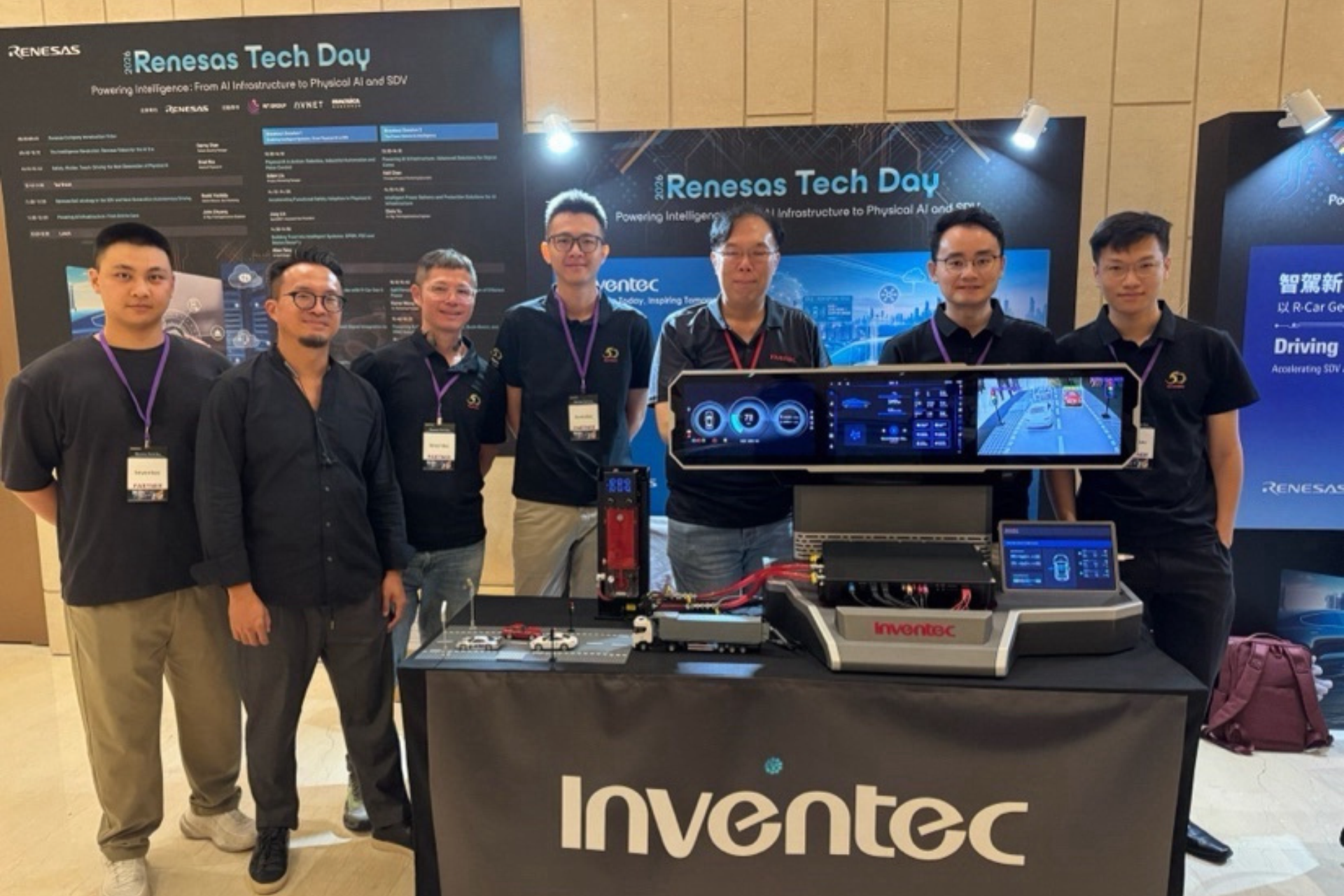
At Renesas Tech Day, Inventec showcased an automotive computing platform developed based on the Renesas R-Car Gen5 SoC. Through a live hardware demonstration, Inventec highlighted its capabilities in automotive system architecture, hardware design, and hardware-software integration.
Unlike traditional development models centered around individual ECUs and project-specific designs, SDVs place greater emphasis on shared computing platforms, hardware-software decoupling, and the continuous evolution of software functions throughout the vehicle lifecycle. As ECU functions are increasingly consolidated onto higher-performance computing platforms, system design must also address computing performance, in-vehicle networking, functional safety, cybersecurity, power and thermal management, OTA updates, and long-term software maintenance.
“The collaboration between Renesas, Inventec, and P3 demonstrates how ecosystem partnerships can accelerate software-defined vehicle development. By combining advanced computing, scalable platforms and software, we enable customers to reduce complexity and shorten time-to-market,” said Aish Dubey, Vice President and Head of the HPC SoC Division at Renesas Electronics. “That starts with R-Car SoCs and R-Car Open Access (RoX). Reusing software across vehicle platforms and leveraging an open ecosystem enable OEMs to bring new vehicles to market sooner.”
“The evolution toward SDVs is not simply about increasing the computing performance of individual ECUs. More importantly, it requires a system architecture that enables both hardware and software to continuously evolve. Through platform-based and modular designs, together with collaboration across the semiconductor and software ecosystem, we aim to build more flexible and scalable automotive computing platforms that can help customers accelerate the development and integration of next-generation SDV systems.” Said Lino Li, Vice President and Head of the Automotive Electrics BU at Inventec.
The demonstration also integrated SPARQ OS, P3’s in-vehicles infotainment system based on Android Automotive OS, running directly on Inventec’s R-Car Gen5-based hardware platform. By bringing together the SoC, hardware platform, and software technologies, the demonstration illustrated a practical model for collaborative development and system integration among different technology partners within an SDV architecture.
P3’s pioneering solution, SPARQ OS is the rapidly developing IVI platform based on Android Automotive OS, the fastest growing in-vehicle operating system in the world today. SPARQ OS’s cockpit platform includes a diverse app store, smart navigation, digital and personal voice assistant, charging, media and entertainment. It features fully automated over-the-air software and firmware updates, ensuring always-up-to-date functionality and promoting sustainability.
By choosing SPARQ OS infotainment, OEMs gain the power to elevate the driving experience in terms of utility, safety and enjoyment. Meanwhile, vehicle manufacturers can differentiate, while reaping reap multiple operational benefits, cost efficiencies, and new monetization opportunities.
“We are proud to see SPARQ OS, our Android Automotive-powered infotainment, integrated into Inventec’s hardware, demonstrating the strength of our technology and our commitment to delivering innovative, reliable, and scalable AAOS solutions,” said Marius Mailat, CTO & Managing Director of P3.
“This collaboration represents an important step in bringing our vision to life, and we look forward to showcasing the capabilities of our integrated solution at Renesas Tech Day.”
Within the demonstrated architecture, the Renesas R-Car Gen5 provides the SoC foundation for automotive computing, while Inventec focuses on system architecture, hardware platform design, and system integration. P3 Group contributes its software technologies to the platform. This combination reflects the automotive industry’s broader transition from highly customized, project-based development toward reusable platforms and ecosystem-based collaboration.
For Inventec, SDV development is not simply about increasing the computing capability of individual ECUs. It represents a broader transformation encompassing vehicle E/E architecture, hardware platforms, software development models, and the roles of different players across the automotive supply chain. Through platform-based and modular design, different software functions and applications can be more efficiently integrated into a common hardware platform, improving platform scalability and accelerating subsequent system development.
As vehicle computing continues to evolve toward centralized computing and zonal architectures, closer coordination between hardware and software will become increasingly important. Inventec will continue to invest in Vehicle Computing, Zonal Architecture, and SDV-related automotive platforms while collaborating with semiconductor and software ecosystem partners to strengthen capabilities spanning hardware design, system integration, and software validation in support of next-generation vehicle architectures.
About P3:
With 30 years’ experience in automotive industry consulting and software development, P3 creates customized In-vehicle Infotainment (IVI) systems based on Android Automotive OS, the fastest-growing IVI operating system today. SPARQ OS is P3’s pioneering IVI solution that helps car manufacturers to differentiate by delivering advanced top-bottom custom Human-Machine Interface (HMI), service layer and Vehicle Hardware Abstraction Layer (VHAL) integration. Major car, truck and motorcycle makers have benefitted from P3 innovations, having deployed SPARQ OS as their core IVI system. P3 digital services is part of P3 group, a leading international technology consulting and software development company with a rapidly growing team of more than 1,900 consultant engineers working to develop and implement solutions to today’s complex technology challenges.
www.sparqos.com www.p3-group.com
Representative Director, P3 Japan:
〒160-0022, 東京都新宿区新宿4-1-6,JR新宿Miraina Tower18階